

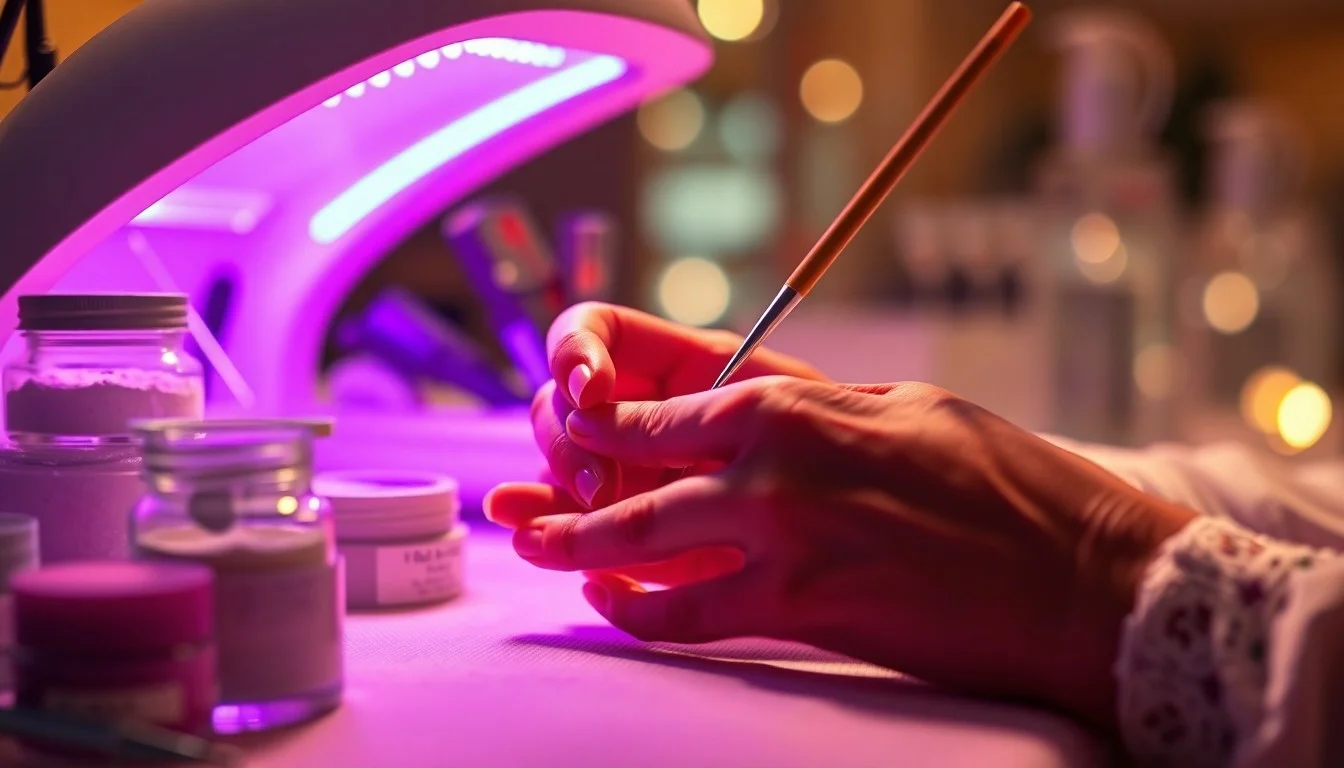
Beyond Basic Polish: Artificial Systems
To scale your income, you must master structural nail systems. These allow you to extend the length of the nail and correct shapes, commanding higher prices.
Mechanism: A monomer liquid reacts with a polymer powder to create a hard protective layer. It cures by air drying.
- Pros: Extremely durable, hardest material, fixes broken nails, air cures (no lamp needed).
- Cons: Strong odor (requires ventilation), requires skill to manipulate ratio, non-flexible (can break if hit hard).
- Best For: Clients who are hard on their hands or want extreme length.
The Art of Curing: UV vs. LED
Understanding your lamp is critical. Undercured product leads to lifting and, worse, contact dermatitis (allergies).
UV Lamps
Use fluorescent bulbs to emit a broad spectrum of UV light. Curing takes longer (usually 2 minutes per coat). Bulbs degrade and must be changed every few months.
LED Lamps
Use Light Emitting Diodes. Much faster curing (30-60 seconds). Bulbs last for years. Narrower light spectrum, so ensure your gel is compatible (most modern gels are).
Wattage Myth
Higher wattage doesn't always mean better. It's about the quality of the diodes and their placement. You need a lamp with bulbs positioned to hit the thumbs and sides, not just the top.
Nail Art: The High-Margin Differentiator
Nail art is pure profit. A $5 pot of glitter can generate hundreds of dollars in revenue. It separates the "technician" from the "artist."
Pricing Strategy: Never give art away for free. Even a simple "accent nail" uses product and time. Create a menu: Level 1 (Simple lines/dots) $5, Level 2 (French/Ombre) $10, Level 3 (Intricate) $20+.